Showing posts with label philippine terno. Show all posts

Wednesday, August 1, 2012

THE ESSENCE OF A NATIONAL COSTUME

By: Jetset Alejandro

When pictures of Miss World candidates came out and they are in their national costumes, the reflex action of this writer is to say that, wow! - the national costume is back in Miss World. As for this writer, it is but proper that the national costume should be put back into the limelight even if it were only during the Dances of the World portion. Here are 125 candidates from all over the world and basically putting the concept of unity among diversity. And such diversity is underscored in every candidate’s national costume. It is such a nice feeling that the Miss World Organization was able to group 125 candidates of varying beauties, faces, persuasions, intelligence, talents but unified all of them in their pursuit for the title of Miss World 2012 – the Beauty with a purpose.


Miss World 2102 Candidates in the National Costumes for the Dances of the World Segment Audition

The national costume is basically a national essence. It represents the cultural and fundamental nature of the country that the candidate represents. It speaks of the country’s history and heritage. It shows the emotions and feelings of the country it represents. It shows the spirit and the soul of the nation. And as such, purists have always something to say when we see a national costume being paraded by a certain country and does not adhere to its culture and history. A very good example is the costume of Miss Australia which she would show during the national costume presentation.


Miss World Australia 2012 in an aborigine inspired costume


Writers, fashion designers and the like had all something to say about her costume. Some say that it is a “travesty” and a national joke. Australians react a lot to what have been passed off as their national costume. Such reaction is acceptable because in reality, Australia has no national costume. In the Philippines alone, there is a continuing debate about its national costume. Given the varied culture presented by the different islands in the country, each local costume has its own distinguishable characteristics that could be presented globally. Sometimes, these characteristics are incorporated into the national costume itself which is the “terno” and the creative Filipino designer gets applauded because of their ingenuity.


Miss World Philippines 2012 was crowned in the Philippine pageant donning a blue terno which is the Philippine National Attire for ladies

I believe the national costume presentation should be continued and pursued every year not only for Miss World but also the other beauty competitions like Miss Universe, Miss Earth, Miss International and so many more. The national costume presentation allows us to see the evolution of the others’ national costume too. With the globalization of the world that is making us literally a homogenous, society, the use of the national costume even just for beauty competitions makes us more aware of others’ cultural identity and even more so our own cultural identity. It makes us also appreciate and respect other’s culture. The national costume is a product of each and everyone’s own heritage and as we reach out to people during the competition, we are also embracing the other candidates’ heritage. Thus we can see, the national costume is not only an identification of who you are but it has become a bridge among people joining one another in a competition in displaying what is unique among them.


Thursday, November 17, 2011

THE CONTINUING DEBATE ON THE PHILIPPINE NATIONAL COSTUME

by Dominador Agbayani


When pageant fans bicker about the kind of national costume our candidates will have to wear in their international contests, we start to wonder why they have to do this. Even foreigners are apt to ask this question. It does not surprise me because the national dress identifies the national identity. I have been to different parts of the world and when you see a person with the way he/she dresses, you can easily identify where that person came from. 

Even dresses are made to convey a particular statement. In one pageant I have watched, there is a portion that the girls parade in their safari costumes. The aim is to project that they are for wildlife preservation – something that I found ironic because the costumes were made of wildlife parts and thus, it would seem that the creators of the costumes devastated wildlife instead of preserving it.

In a write-up by Mina Roces, entitled “Gender, nation, and the politics of dress in the 20th century Philippines” she chronicled how the barong Tagalog and the terno became political tools and a statement for the powerful and mighty during the Marcos regime. [1]  The many photographs of the then First Lady Imelda Romualdez in her dazzling terno showed how she promoted the country – as she adhered to her “only the good, true and the beautiful” concept. [2, 3]


Undoubtedly, the terno was promoted very actively most especially in pageants. Although the Philippine costume was less successful in the Miss Universe and Miss World beauty pageants, the terno was very much promoted and accepted in the Miss International beauty pageant.

 In 1972, 1976 and 1979, the Philippine candidates in their terno won honors as the Best in National Costume. The Philippine candidates were much luckier in the Miss Maja International beauty pageant. In 1979, 1980, 1981, 1983, 1985, 1986 and 1988, Philippine representatives won the award. In the defunct Miss Young International Pageant, Dorothy Sue Bradley in 1979, won also the Best in National Costume. [
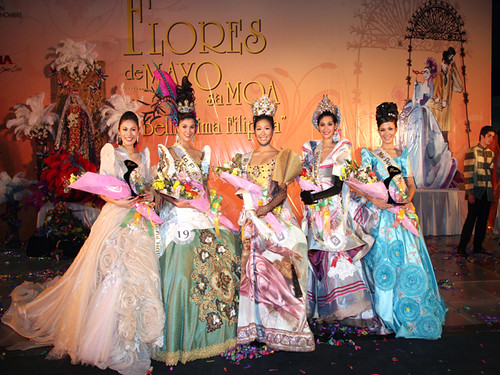
4] Would it be an understatement if we say that the terno’s popularity was seen and felt during the Marcos’ years? Yes, maybe but for every Filipino competitor, if the National Costume wins, then it becomes a matter of national pride in whoever’s regime it was. The names of the following designers- Pacita Longos, Juanita Roa, and Ramon Valera were said to be the fashion trendsetters when the terno is concerned. [5] The terno had become the fashion fare for state functions and affairs such as the rigodon de honor. It had become the staple of Flores de Mayo processions, coronation nights and stately functions in Malacanang Palace. [6]

I have read in forums referring to the Maria Clara type of costume as Filipiniana and the other Philippine costumes as that of the Igorots, Manobos, Subanon and other regional costumes as ethnic or folk costumes. These forum writers are misled into believing that the Maria Clara dress is the real Filipiniana costume because in essence, all these costumes which originated in the Philippines are all lumped up in a singular term called “Filipiniana.” The reference to the Maria Clara costume as the only Filipiniana is maybe derived from the fact that it is referred to as the Philippine National Costume for females. [3]      Furthermore, the original female national costume is the baro at saya which through the years has been transformed into the Maria Clara dress that eventually transformed into the traje de mestiza. [5, 7] Eventually the traje de mestiza was transformed to the present appearance of the present terno.

Criticisms abound when beauty queens parade in front of a foreign audience using the so-called national costume when they feel that it does not represent the true culture and identity of our nation. Critics bewail the organizers use of foreign designers doing our national costume. They agree generally that those done by foreign designers do not embody the Filipino soul and thus what is being paraded is a costume which is not authentically Filipino. The question of the national costume in international pageants has become not only a cultural one but has become political as well. Since the franchise holder for Miss Universe in the Philippines is Miss Stella Marquez Araneta, a former Miss International and a Colombian by birth, she is being accused of favouring her compatriots in the creation of the Philippine National Costume. She probably believes that the essence of the National Costume is in the person who wears it and not the designer who made it.


Others however, insist that the national costume should be Philippine and Filipino made to embody the ideals of a unified nation. On the other hand, sticking to one type or derivative of a costume makes other regional or ethnic groups marginalized. There has been a clamour amongst Filipino pageants fans to show other Philippine costumes because these too are more Filipino in essence compared to the Philippine terno which had great influences of Spain and once marked the thrust of the Marcos dictatorship. Although, it was Manuel L. Quezon who started the nationalist sentiment that the Barong Tagalog and the baro at saya should be our Dress Emblem when he was fighting for our independence from the Americans. It is not surprising therefore to see ethnic costumes paraded by our pageant queens in their international competitions. To a certain extent or degree, such show of the national costume demonstrates that we are a heterogeneous mix of culture and not a pure race as other countries would like to project. The great question has evolved in this debate of what national costume should be used for our candidates – is it the harmonized costume as exemplified by the terno or will it be a representation of our regional or ethnic costumes? I really don’t mind showcasing any of our Philippine costumes in the international arena as long as it is authentically Filipino...